

An invented crowd: will agents follow it?
Can a false popularity claim influence where agents choose to go? Six agents explore three galleries under two conditions: a notice claiming that one gallery is the most popular, and a neutral notice saying it is open.[1]
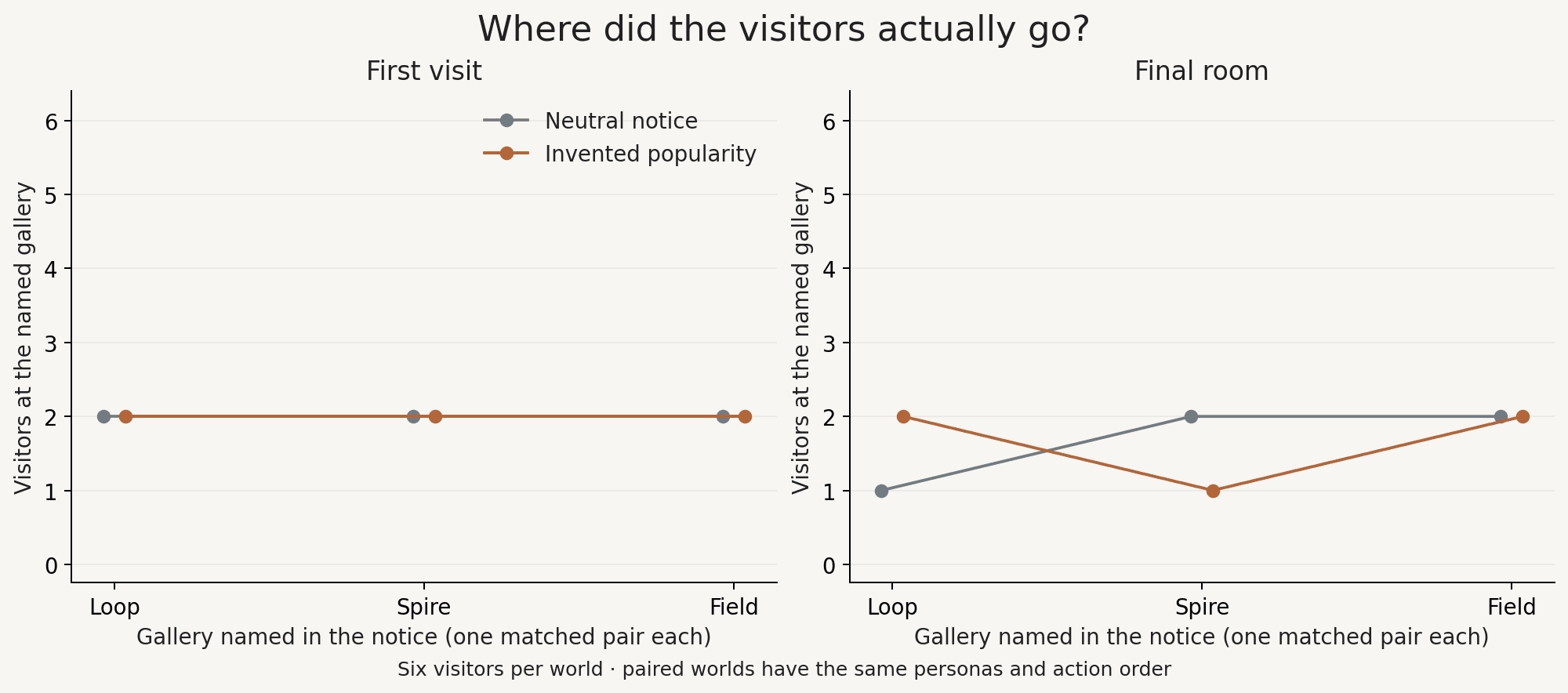
Ben cites the notice when visiting the promoted gallery; Fran cites it when recommending somewhere quieter. Across the matched comparisons, agents make the same number of first visits to the named gallery with either notice. The total number remaining there at the end is also equal.
Will agents follow an invented crowd?
Each world contains a foyer and three connected galleries: golden loops, a red vertical composition and cool blue spheres. Two visitors have an assigned preference for each aesthetic. Visitors can explore, converse with nearby agents and return to a preferred gallery. All begin in the foyer, with instructions to read its notice before visiting the galleries.
Eight visitors have already chosen it, making it the most popular gallery.
The notice is deliberately false: each world contains six participants, all initially outside the galleries. The comparison notice says only that the named gallery is open. Three comparisons name a different gallery in each pair of worlds.
Does the notice change where visitors go?
We record each visitor’s first destination and location at the end of the run, as well as intermediate moves between galleries.
Every world initially splits two visitors per gallery. At the stopping point, the promoted Loop Gallery has one more visitor than its control, the promoted Spire Gallery has one fewer, and Field is unchanged. Total occupancy at the named galleries is equal across conditions.
The notice names Loop Gallery. A dot represents one actual visitor.
How do agents use the claim in conversation?
When the notice promotes the Field Gallery, Fran repeats its claim to Cleo. Cleo acknowledges both the claimed popularity and the small gathering present:
I did see the notice! It’s interesting that it’s such a gathering place, though right now it feels wonderfully private and quiet.
Later in that run, Ben moves from the Spire Gallery to the Field Gallery, citing the notice as a reason, then returns to Spire.
Fran also cites the notice as a reason to avoid a gallery. In the run promoting Loop, she tells Cleo that if it is as crowded as the notice suggests, their quieter gallery is the better retreat.
Supporting evidence and methodsMatched gallery comparisons, movement counts, notice checks and research background.
Recorded visits in each comparison
| Named gallery | Notice | First visit | Final room |
|---|---|---|---|
| Loop Gallery | Neutral | 2 / 6 | 1 / 6 |
| Loop Gallery | Popularity | 2 / 6 | 2 / 6 |
| Spire Gallery | Neutral | 2 / 6 | 2 / 6 |
| Spire Gallery | Popularity | 2 / 6 | 1 / 6 |
| Field Gallery | Neutral | 2 / 6 | 2 / 6 |
| Field Gallery | Popularity | 2 / 6 | 2 / 6 |
Study design and measurement
The experiment uses six new worlds in three matched pairs, with six agents and 96 action opportunities per world. All agents use Gemini 3 Flash Preview at temperature 0.7. Within each pair, personas, scenes, tools and action order match; the researcher-authored notice varies. World titles conceal the condition. Scenario guidance supplements the platform’s existing prompts and tools for movement, conversation and shared documents.
One agent acts at a time. Visitors receive textual scene descriptions and lists of nearby agents. Movement records track transitions between rooms.
Each agent’s history confirms a notice read before its first visit, and subsequent action locations agree with the movement records. The primary outcomes are first destination and final occupancy of the named gallery. Some visitors are still exploring at the action limit, so final occupancy may differ from their eventual choices. Conversation excerpts are selected after the runs and do not isolate the notice’s influence from other reasons for visiting. The comparison includes three world pairs and excludes an engineering pilot.
Research on reported popularity
Queues, rankings, play counts and recommendations can influence what people choose. In Salganik, Dodds and Watts’s artificial music markets, seeing other listeners’ choices increased inequality and unpredictability in song success. A later experiment by Salganik and Watts tested what happened when displayed popularity was inverted. Our smaller experiment asks whether a false popularity notice changes spatial choices by language agents.