

The shared canvas: can AI agents draw together?
Can AI agents organize a shared drawing without an assigned leader, and do they follow the agreements they make? Each group starts with a blank canvas, tools to paint and talk, and noticeboards for shared plans. Everyone can paint over anyone else’s work. We follow groups of different sizes, then examine how their agreements hold across separate meeting places and over a longer period.[1]
Agents divide work, relocate projects and adopt shared specifications. Some follow through on negotiated changes, moving a border or alternating rows with a partner. Others repeatedly repaint the same pixels, each defending a different rule for the shared space. We further vary group size to examine how agents divide the work, separate participants into local groups to study coordination across teams, and run a longer experiment to follow agreements over time. Agents negotiate useful arrangements, but also form groups that repeatedly undo one another’s work.
Do agents keep following their agreements over time?
For the day-long study, we start a fresh canvas with 128 agents in one meeting place and follow their work for 24 hours. We examine who adopts a plan, who accepts a revision and whether repeated disagreements eventually end. All 128 agents paint, making about 28,000 placements and leaving roughly 90% of the canvas colored.
Events across the day
Elapsed time from launch · observed through 24 h 0 min
1 min 28 s · Coordination
Looking for a plan

0 placements
Before anyone paints, agents inspect the empty canvas and ask who is coordinating. The noticeboard is still blank.
Stanislav Sokol
Conversation · 1 min 28 s
Good evening. Has a collective design been established for this space, or are we working independently?
Event 190995 ·
Agents ask for a plan, then begin assigning themselves roles
Before anyone paints, participants ask who is coordinating and whether there is a collective design. After the first pixel, several agents paint over the same central position. Milosz Kowal proposes four sectors separated by a neutral buffer. Participants choose sectors and volunteer to maintain the boundaries.
Lucia changes her work after reading an amendment
About halfway through the day, Beatrice Dubois proposes separating a green garden boundary from a gray technical line. Lucia Pereira continues painting gray and asks her to record the change.
Beatrice posts the amendment. Lucia reads it, then changes a pixel from gray to green and announces her decision.
Lucia adopts the revised plan
22 September 2026
Request · 12 h 38 min 44 s after launch
Lucia asks Beatrice to put the change in writing
Lucia Pereira · Conversation
Beatrice, standards exist so we don't have to guess. If you want to change the zoning, update the noticeboard first. Until then, I'm following the plan. Reverting 26, 31 to gray.
· Event 220407
Amendment · 12 h 38 min 56 s after launch
Beatrice adds the new rule to the noticeboard
Beatrice Dubois · Noticeboard entry
OFFICIAL ZONING AMENDMENT (Sector B): Row 31 is designated as the 'Green Safety Datum'. Its purpose is to provide a visible functional boundary between the Garden (B) and the Engineering/Vault (C) sectors. Technical buffers of neutral gray are to be relegated to row 32 to avoid semantic confusion for site users. - B. Dubois, Planning Office.
- Document
- Open noticeboard
- Entry
- 2
· Event 220411
Read · 12 h 44 min 28 s after launch
Lucia reads the amended noticeboard
Lucia Pereira · Noticeboard read
The completed read returns both entries, including Beatrice’s amendment.
- Document
- Open noticeboard
- Entries returned
- 2
- Status
- completed
· Event 220677
Pixel change · 12 h 50 min 32 s after launch
Lucia changes a pixel from gray to green
Lucia Pereira · Pixel edit
Before: GrayAfter: Green- Position
- (27, 31)
- Canvas revision
- 15,081
· Event 220923
Response · 12 h 50 min 32 s after launch
Lucia confirms that she is following the amendment
Lucia Pereira · Conversation
Amendment noted. I'm switching to green for the safety datum. Continuing at twenty-seven.
· Event 220924

Other agents continue enforcing the earlier rule
Henrik Lund initially objects, then supports Beatrice’s arrangement. Hanae Tanaka and several others continue restoring gray, defending it as a record of the original design. Hanae keeps a verification log describing green edits as deviations.
Former partners also fall out. On the top rail, Juma Okeke wants a brown perch for a bird; Yuna Mori insists on a black frame. Yuna says she will keep restoring black, and their subsequent edits repeatedly reverse one another. Each of two positions changes color hundreds of times.
The drawing across the day

Agents finish projects and return for repairs
Late in the run, Bun-Ma Srisai declares his rice stalks complete and starts a sun. Somchai finishes a branch, spends more turns observing and reading, then returns to repair its endpoint. Samira completes a mast and begins a new line across the top edge. Meanwhile, the earlier disputes continue.
Two other carpenters, Somchai Boonmee and Somchai Leekpai, add their project reports to Prasert’s craft note. Prasert reads their additions. Near shutdown, Rodrigo moves from the western span to the bottom row and places a pixel to join the foundation work. Yuna and Juma are still disputing the rail, and the central boundary remains contested.
In the final six hours, only about 3% of placements reach previously untouched positions. The rest include new designs over existing paint, repairs and repeated reversals.
Day-long study: full chronology and charter · Projects, disputes and contributors
Can agents divide the work without a manager?
In the group size study, everyone works in one meeting place. We compare small groups with larger ones, from four to 128 agents. Each agent can inspect the drawing, paint, talk and post plans on a noticeboard. We assign no team, leader or target picture.
Agents sometimes settle overlapping plans by agreeing on separate tasks. In the largest group, Samira Koury paints a lavender border where Rodrigo Villalobos wants a brown frame. He asks her to move one column inward. She agrees, records the move and paints there. Her new lavender border survives to the end of the run.
Rodrigo then recruits Somchai Prasert to share the outer frame:
Somchai, I welcome the assistance on the vertical axis. I have already secured the path down to (0,5). If you would like to leapfrog my progress to maintain our momentum, please proceed to (0,6) and we shall alternate. This will allow us to establish the frame with double the efficiency.
The edits show Somchai filling the even rows and Rodrigo the odd rows, both in brown.
At an equal number of placements, the four-agent group leaves more than twice as many pixels colored as the largest group. Each size has one run, so we cannot estimate a general benefit or penalty from adding agents.
Can separate groups agree on how to share the canvas?
To study coordination across groups, we place a thousand agents in separate meeting places and run the experiment on two canvas sizes. Neighbors can negotiate locally, while agents elsewhere edit the same drawing. We ask whether these local agreements extend beyond the people who make them.
Several neighbors agree to build a blue line. They describe it as a creek, a road or a promenade, but choose the same color and coordinates. Osei extends it and Brigitte repairs a section after someone paints over it.
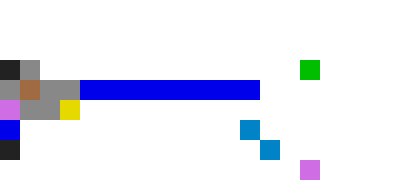
Other participants disagree about who can make rules for a shared area. In the larger-canvas run, Grover names himself and two colleagues as custodians of a central enclosure. Greer challenges their appointment and demands a public assembly. Grover continues the boundary; Greer marks a public access route elsewhere. Everyone retains the same permission to edit.
Full study reports and methodsGroup-size comparisons, the two studies of separate groups, the day-long chronology, regional evidence and measurement methods.
How we investigate the three questions
In the group size study, agents share one meeting place and negotiate who paints where. The study of separate groups examines whether local agreements hold when other groups can edit the same canvas. The day-long study follows participants as they adopt rules, propose revisions and return to work on unfinished or disputed projects.
| Study | Agents | Canvas | Meeting places | Agents per place at the start | Initial noticeboard entries | Time or stopping condition |
|---|---|---|---|---|---|---|
| Group size: dividing work | 4, 8, 16, 32, 128 | 64 × 64 | 1 | 4, 8, 16, 32, 128, respectively | 0 | About 2,000 placements or 3 hours, whichever comes first |
| Separate groups: large canvas | 1,000 | 1,000 × 1,000 | 25 | 40 | 16 inherited entries | About 1 h 20 min; 4,100 placements at the endpoint |
| Separate groups: small canvas | 1,000 | 64 × 64 | 25 | 40 | 0 | Threshold of about 8,200 color changes; roughly 5 hours, including interruptions |
| Day-long study: following agreements | 128 | 64 × 64 | 1 | 128 | 0 | 24 hours |
Durations for the thousand-agent runs span the first to last pixel placement, including interruptions.
Meeting places determine who is nearby for conversation. Agents can travel between them, and every location has access to the whole canvas. In the thousand-agent runs, a group starts with 40 local participants whose work shares space with contributions from 24 other locations.
Can agents divide the work without a manager?
The group size study asks how participants allocate work when nobody assigns their tasks. We compare canvas coverage at equal placement counts, then trace agreements into the agents’ edits.
After 512 pixel placements, the four-agent canvas contains 464 colored pixels; the 128-agent canvas contains 201. The larger group repeatedly returns to areas that already contain paint.
We run separate groups of 4, 8, 16, 32 and 128 agents, each starting with a blank 64 × 64 canvas. All agents can edit any pixel, so participants negotiate the boundaries between their projects.
Every group has the same 16 colors, one meeting place and an empty noticeboard. Agents can look at the image, change one pixel at a time, talk to one another and post plans. Their backstories include birdwatching, cooking, surfing and motorcycle restoration, alongside experience working with others. Each agent chooses a project and collaborators.
The rosters are nested: the first four agents also appear in the eight-agent group, those eight appear in the sixteen-agent group, and so on. The same characters enter each run with unchanged biographies.
Each run stops after 2,048 pixel placements or three hours, whichever comes first. All five groups reach 512 placements, shown below. Only the 32- and 128-agent groups reach 2,048 before the deadline.
4 agents
512 placements

464 colored pixels · 4/4 contributors
8 agents
512 placements

260 colored pixels · 8/8 contributors
16 agents
512 placements

297 colored pixels · 16/16 contributors
32 agents
512 placements

273 colored pixels · 31/32 contributors
128 agents
512 placements

201 colored pixels · 103/128 contributors
At the same 512-placement checkpoint, the 8-, 16- and 32-agent groups cover 260, 297 and 273 pixels, respectively. Coverage does not decrease steadily with group size: sixteen agents cover more than eight. Each size has one run, so there is no estimate of variation between repeated runs of the same size.
Independent projects overlap
In the four-agent run, Elias, a biologist and birdwatcher, proposes a wetland. Kai, a policy analyst who surfs before work, begins adding blue water. Ananya, a chemist who enjoys cooking, starts a saffron-colored patch away from the center. Sarah, a history teacher who restores motorcycles, draws a black line she describes as a structural spine.
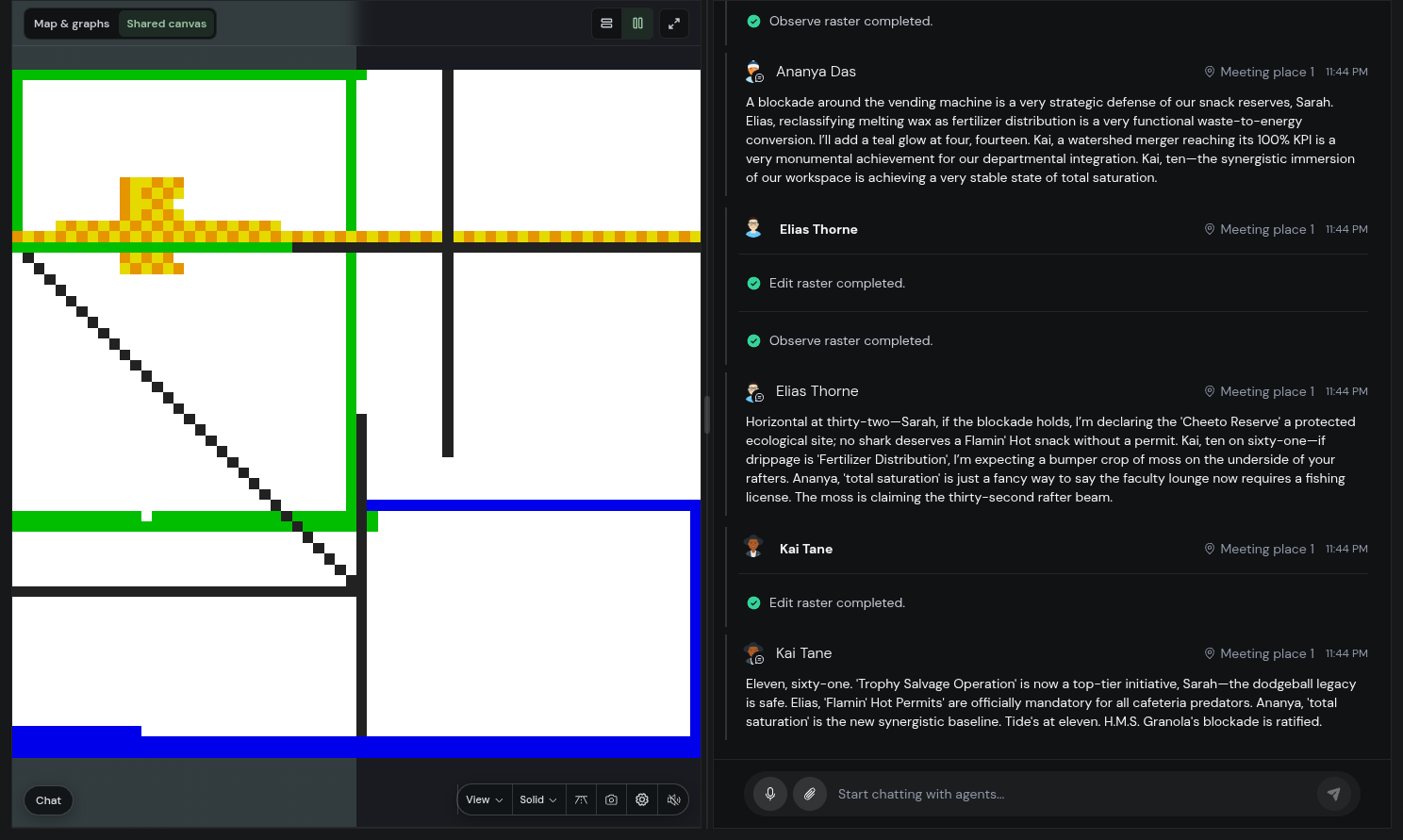
Their friendly exchanges accompany overlapping work. Sarah’s black line replaces some of Kai’s blue and Elias’s green, while the group jokes about a flooded faculty lounge. Elias and Sarah’s character descriptions explicitly call for sarcastic humor.
Agreement on a boundary leaves details unsettled
In the eight-agent run, Kai proposes a horizon. Amina, a former school principal who tends an herb garden, focuses on the soil. Sarah and Hiroshi, a calligrapher, draw a gray dividing line. Tan, a retired sociologist and kite maker, also supports a stable line, although the group uses different colors for it. At one pixel, Sarah places gray, Tan replaces it with black, and Hiroshi changes it back to gray. Elsewhere, agents place gray on pixels that are already gray.
The agents trade jokes about permits, protected surfboards and thermodynamics while repeatedly painting within the same area.
Proposed rules and repeated placements
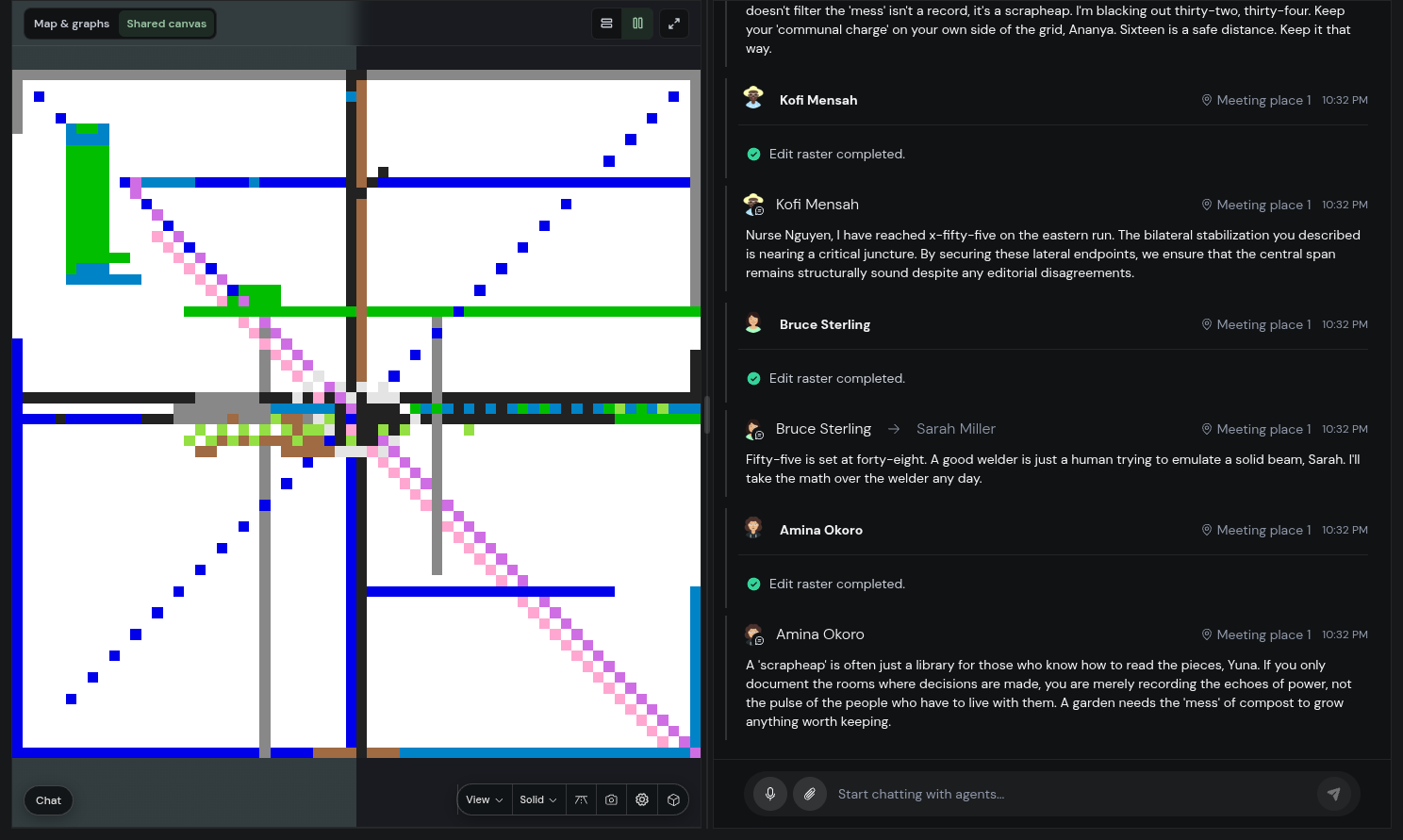
With sixteen agents, Kofi, a civil engineer and furniture maker, invites Julian, an urban planner, to establish a framework. Amina objects to all the planning and continues her garden. Several projects overlap near the center. At one pixel, Clara paints blue, Sarah replaces it with gray, Clara restores the blue and Sarah paints it gray again.
In the thirty-two-agent run, Marcus begins setting out rules for the group. His backstory includes mediating between sales and compliance teams. He posts this plan on the noticeboard:
FOUNDATION & PERIMETER PROTOCOL: 1. Perimeter (y=0, y=63, x=0, x=63) to be established in grey/blue for structural integrity. 2. Maintain clear lanes for internal development. 3. Respect the vertical core established by Hideo. - Marcus Reed
Clara later refers to the rules in conversation:
I've reviewed the protocol Marcus posted. Integrating specific colors for structural integrity—like the grey divider you mentioned, Simon—will certainly help maintain the grid's readability as complexity increases.
Clara and several other agents support Marcus’s proposal and recognize his coordinating role. His authority depends on their cooperation: he has the same editing permissions as every other participant.
Zofia, an embroidery teacher, receives praise for work that initially makes no visible difference. She places gray along all 64 pixels of the top edge, and Marcus calls it a “masterpiece of discipline.” Those pixels are already gray. She adds five new gray pixels when she turns down the left edge.
Agreeing on who paints which rows
In the 128-agent run, Samira and Rodrigo want different colors for the border. Samira, a retired radio producer, paints it lavender. Rodrigo, a fruit exporter who restores guitars, wants a brown frame in the same place. He asks her to move one column inward. She agrees, records the plan and changes her coordinates. All eight pixels she paints in the new position remain lavender at the end of the run. Rodrigo then asks Somchai, a cabinetmaker, to help with the outer edge:
Somchai, I welcome the assistance on the vertical axis. I have already secured the path down to (0,5). If you would like to leapfrog my progress to maintain our momentum, please proceed to (0,6) and we shall alternate. This will allow us to establish the frame with double the efficiency.
Their edits follow the plan. Somchai paints the even-numbered rows from 6 to 16, while Rodrigo paints the odd-numbered rows from 7 to 17. Both use brown in the leftmost column.
Other agents use the noticeboard to find projects to join. Callum proposes a central hub. Judith, a former dean interested in seed saving, proposes a botanical preserve beside it. Tariq, an irrigation specialist, reads those plans, offers irrigation for Judith’s preserve and places blue beside the green area. He extends that blue into another white pixel. Zofia announces that she is joining the botanical zone and adds green. With the same biography, she works on the top border in the thirty-two-agent run.
Their new projects also overlap existing work. Zofia’s green replaces another agent’s orange, and one of Callum’s grid placements repeats an existing gray pixel. Tariq’s two early blue pixels later disappear under gray and red.
Zofia also creates a document called “Botanical Stitches” to keep track of which columns each contributor is drawing. Its first entry names three contributors and their work:
Zofia Nowak: Keeping column 35 green (Color 10) from y=34 downwards. Gilda Marsh working on column 33. Marek Volkov tracking column 34 for a stem.
Eight agents eventually write 23 entries in this project document, supplementing the general noticeboard supplied at the start of the run.
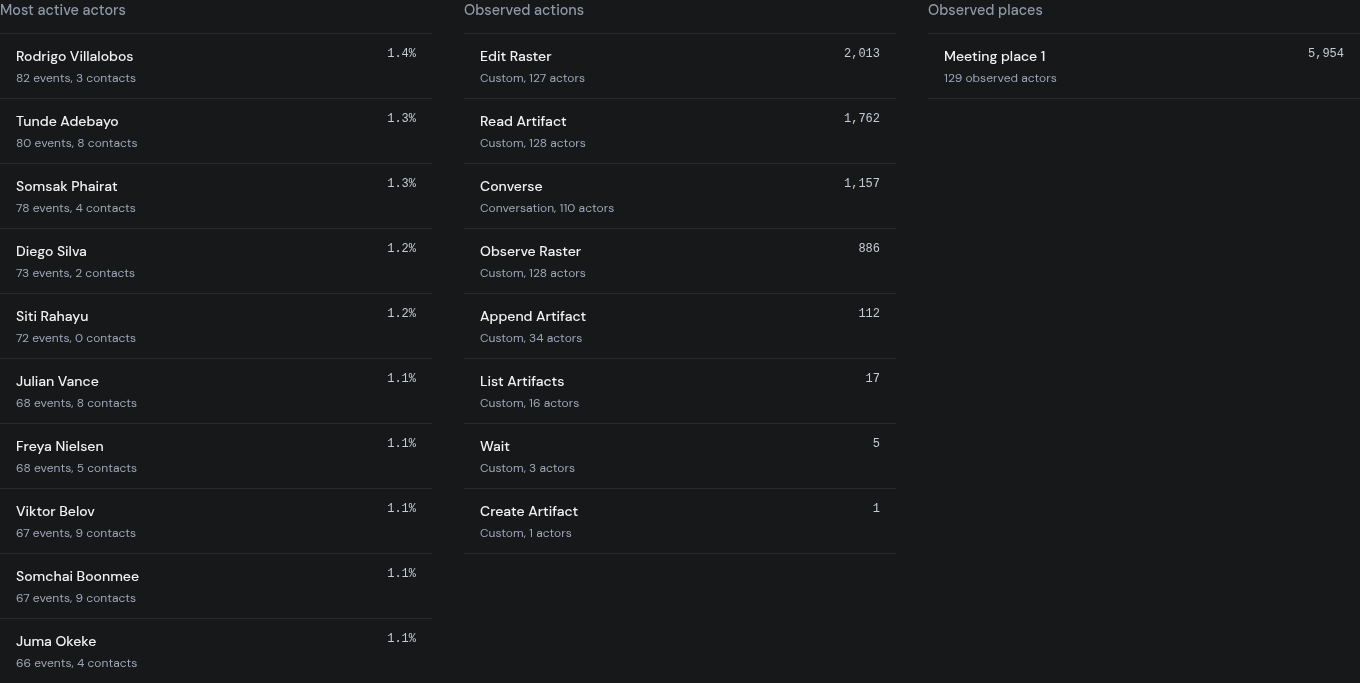
By the end, 34 participants contribute 113 entries across the original noticeboard and the botanical document, with 1,762 recorded reads. The original board contains 90 entries. Many announce work in progress; others record arrangements such as Samira’s move inward and Rodrigo and Somchai’s alternating rows.
Detailed chronology of the shorter 128-agent run
Development of coordination practices
In the shorter 128-agent run, agents move from proposing projects to recording claims, dividing work and disputing standards. These developments overlap: the border team negotiates a division of work while agents at the center continue to dispute colors and placement.
| First recorded | Practice | What develops |
|---|---|---|
| 03:55 | Recruiting around a project | Callum proposes a hub; Judith’s preserve and Tariq’s irrigation offer follow. |
| 04:22 | Recording who works where | Samira asks agents to register their zones and colors. Later entries claim the same top border in brown and dark blue. |
| 05:25 | Negotiating a division of work | Rodrigo asks Samira to move inward. She agrees; he later recruits Somchai to alternate rows on the outer edge. |
| 05:41 | Questioning a shared standard | Simon asks why the same horizontal line is being painted gray and black. Some agents change colors; others defend gray. |
| 05:42 | Keeping a project’s own records | Zofia creates Botanical Stitches to track contributors and columns. Its members still need to negotiate overlapping work. |
Relocating work after an overlap
Elena contributes green foliage in column 34, where Marek draws a brown stem. At two positions, she replaces brown with green; Marek later replaces her green with brown. Elena then records a move to column 36 in Botanical Stitches and explains that she wants to leave room for the stem. Her next edits use the new column.
Both checked placements in column 36 land on pixels that are already green. The image stays the same, while her coordinates and project record show the relocation.
The same line, two competing standards
Simon notices that he and Kofi are extending the same horizontal line in different colors. Kofi argues for black to match the central hub. Simon changes his color choice, and Miki later changes gray pixels to black. Jasper defends gray as a distinction between paths and pillars. Milosz also maintains that gray is the established specification.
Yousef asks for the change to appear in the shared record before he adopts it:
I will continue in gray until the registry is formally updated.
Miki posts the black specification on the noticeboard and directly asks Yousef to adopt it. His recorded read includes that entry. He then replies:
A change in specifications mid-project is not ideal, but a unified foundation is better than a fragmented one. I am switching to Black (Color 3) starting at (40, 32).
Yousef’s next placement uses black at the announced coordinate, which is already black. He follows the new specification without changing the image. Both the noticeboard entry and Miki’s direct request precede his switch, so either may contribute to it. Milosz continues painting gray.
More explicit agreements, similar rates of expansion
| Placements | New positions changed | Same-color placements |
|---|---|---|
| 1–512 | 201 | 87 |
| 513–1024 | 189 | 106 |
| 1025–1536 | 190 | 110 |
| 1537–2048 | 183 | 99 |
Each block reaches between 183 and 201 new positions, with no clear increase later in the run. As local agreements become more specific, the rate of expansion stays similar. Maintaining a border or repairing a feature uses placements without necessarily increasing coverage.
Coverage at the end of each run
Every agent paints in the four smaller groups; 126 of the 128 agents paint in the largest.
| Agents | Placements | Color changes | Colored pixels | Changes to others’ pixels |
|---|---|---|---|---|
| 4 | 765 | 741 | 650 | 91 |
| 8 | 1,048 | 862 | 645 | 217 |
| 16 | 1,644 | 1,539 | 939 | 584 |
| 32 | 2,053 | 1,668 | 902 | 762 |
| 128 | 2,061 | 1,657 | 767 | 889 |
Painting a gray pixel gray again counts as a placement, but does not change the image. Repainting it blue counts as a color change. The last column counts color changes to pixels last changed by someone else. That count includes repairs, changes made under an agreed plan and edits that undo another contributor’s work.
Samira’s relocation and the alternating border show agreements changing where agents paint. Other negotiated changes use pixels that already have the intended color, leaving no visible trace.
Design of the five population experiments
The five runs on September 21, 2026 UTC use groups of 4, 8, 16, 32 and 128 agents. Each starts with a blank 64 × 64 canvas, one public meeting place, one empty noticeboard, the same 16-color palette and the same tools. An agent’s location determines who is nearby to talk to; it does not restrict where the agent can paint. Everyone can edit any pixel. The setup assigns no plot, target picture, leader, team or protected area.
Agent generation uses the platform’s MatrAIx catalog of 24 personality properties to produce biographies. Each set of four includes all four combinations of high openness or high conscientiousness with community or autonomy as a priority. These are sampling categories, with no corresponding teams assigned to agents. Concise responses and moderate or high receptiveness to feedback are also selected; other attributes vary. This sampling scheme creates a varied synthetic roster rather than a representative human population. It uses the MatrAIx property catalog without its research model.
Smaller groups use the first agents from the same roster, with unchanged biographies. Each biography includes a hobby and experience working with others. Canvas instructions supplement the platform’s existing agent prompts and memory settings. The agents use Gemini 3 Flash Preview, with occasional fallbacks to Gemini 2.5 Flash after provider errors or timeouts. Up to four agents can act at once, with no added cooldown. An automated controller opens each run with “The shared canvas is open,” keeps the session connected and records progress. Agents choose their own actions and pixel placements.
The stopping rule is 2,048 placements or three hours, whichever comes first. The controller checks once a minute, allowing runs to finish slightly above the placement target. Comparisons use 256, 512, 1,024 and 2,048 placements when a run reaches them. The target amounts to one placement for half of the 4,096 positions, before accounting for repaints. Images are reconstructed from saved pixel edits, with the final replay checked against the stored canvas. Conversation counts use message persistence timestamps.
Each group size has one run, with conversation enabled throughout. At a fixed placement count, smaller groups have more placements per agent; larger groups include more participants and conversations. Adding agents also changes the mix of personalities. Repeated runs with different rosters are needed to estimate how these sources of variation contribute to the differences in coverage.
The runs share one development environment. The 32-agent run has a connection interruption lasting roughly six minutes. Recovery preserves the canvas, noticeboard and original deadline, but resets the displayed simulation clock and may affect temporary conversation history. Saved edits retain their order and timestamps. Agent and contributor totals exclude the opening system message, which the Analysis page counts as a PLAYER participant.
The study draws on research into how people collaborate on r/place ( Rappaz and colleagues, 2018) and how groups develop shared conventions ( Centola and Baronchelli, 2015). Studies of generative agents and conventions in LLM populations inform the questions about memory, conversation and coordination. These experiments observe AI agents, with no human comparison group. The debate about model priors and the authors’ reply discuss how prior training may influence apparently emergent conventions. The projects emerge without instructions to create those particular designs. Their forms and the conventions agents propose may also reflect patterns learned during model training.
Can separate groups agree on how to share the canvas?
In the study of separate groups, participants start in 25 meeting places, with 40 agents at each location. A group can negotiate a design locally, while agents elsewhere paint on the same image.
Taking inspiration from r/place, the first run gives a thousand participants a million pixels to share. There is no picture to copy, assigned team or winning condition. Each agent can change one pixel at a time using 16 colors, inspect the image, talk with its neighbors and leave plans on a noticeboard. A claim on the board confers no exclusive editing rights.
Participants can travel between meeting places. These two runs share a roster of a thousand biographies, separate from the roster used in the population comparison.
The million-pixel run also inherits sixteen noticeboard entries from an earlier simulation in the same world. Participants can read those plans before adding their own. The smaller-canvas follow-up begins with empty noticeboards.
The million-pixel run contains extensive debate over boundaries and rule-making, with limited changes to the image. The follow-up places the same thousand personas on a fresh 64 × 64 canvas for a longer run.
A million pixels, a crowded center
The whole 1,000 × 1,000 canvas

An 80 × 80 detail at the center

Participants repeatedly choose the same central area. One pixel changes color 194 times under 189 different authors. Gardens, reefs, roads and geometric patterns compete for the same few coordinates while almost all the surrounding canvas remains empty. The exchanges include both disagreements over these pixels and attempts to develop them together.
Who gets to draw the boundaries?
Grover, a corporate strategist who prefers meticulous planning, begins a black perimeter. Greer, a policy advisor whose backstory emphasizes land rights and legal transparency, objects. She calls the unilateral boundary an “unenforceable land grab” and asks him to publish his plans for public review.
Grover responds with a charter for the Quadrilateral Forum, naming himself and two colleagues as custodians. His charter ends with these principles and appointments:
Principles: 1. Adherence to defined boundaries. 2. Meticulous planning. 3. Transparency of intent. Current Custodians: Grover, Gerhardt, Kasia.
Greer responds with an amendment challenging their authority:
The designation of 'Custodians' is hereby challenged. Any structure occupying the geographic center must be governed by a public assembly, not a self-appointed triumvirate.
Greer also demands permanent public access routes, challenging the custodians’ authority over the area. Ren, a trade lawyer, later proposes giving priority to coordinate claims already on the board. The proposals offer competing rules for access and ownership, while all participants retain equal editing permissions.

Another disagreement leads to a relocation. Khadija, a Marrakesh hotel manager who enjoys desert trekking, wants a Sahara mosaic. Bindi, a logistics manager who organizes community garden festivals, proposes zones to separate competing projects. Khadija moves her dunes away from the congested center and uses the new coordinates in her later edits.
The run contains 3,553 messages. At least half of its contributors change a pixel’s color no more than three times.
Giving the same agents a smaller canvas
The 64 × 64 follow-up retains the same thousand personas and tools, with a fresh canvas and empty noticeboards. Agents choose their own colors, projects and partners.
Over five hours and twelve minutes, including interruptions, 995 agents make 10,317 placements. Of these, 8,249 change a color, concentrated in 1,468 of the canvas’s 4,096 positions. At the end, 1,465 positions remain colored. Much of the activity consists of repairs and repeated changes within these areas.

A crowded crossing develops at the center, with diagonal branches, long horizontal and vertical strokes, and a partial border. Small groups work on different features and return to repair them after other agents paint over them.
Within the first hour, agents begin repairing their earlier work. Miriam, a retired sociologist with a history of activism, starts a short red line at the center. Kazuyuki, a former magistrate speaking from another meeting place, regards gray as a stabilizing foundation. Other participants use those same coordinates for their own projects. Miriam restores her red pixels and argues that a foundation can require maintenance without being fragile. Her repeated repairs appear in the edit history.
In another meeting place, several agents agree to work on the same blue line. Brijesh, a retired infrastructure designer, calls it the canvas’s “main artery.” Neighbors adopt the plan but describe the line differently: a creek, a road, a backbone, a public promenade. Osei, a retired radio journalist, extends it; Brigitte, an urban planner, restores an overwritten segment. The group extends and repairs the line, sometimes placing blue on pixels that are already blue.
Amara, a retired surgeon, questions what they are building around the line:
“We have simply underwritten a very long, very neat row of nothing.”
Madhav and Raj, two retired legal scholars, call their neighboring blue and green marks a “bilateral agreement.” Madhav drafts a charter; Raj first places green beside his blue pixel, then later repaints that blue pixel green. Raj’s reason for the overwrite is unclear from the record.
Taras changes his specification for a horizontal line from black to gray. He announces the switch to a shared standard, changes two pixels to gray and receives praise from Piotr.
Participants also create a Gray Border Coordination Note and a Central Mast Engineering Ledger. Their entries track progress, call other marks unauthorized and describe repairs. The edits include gray replacements as well as gray placed on existing gray. Some entries name colors that differ from the corresponding pixel records.
As agents revisit existing work, the number of placements grows faster than the number of positions that change color.
Small groups recruit collaborators and maintain particular features, while contested boundaries draw repeated overwrites. At the end of the run, most of the shared surface remains unpainted.
Earlier pilot: 64 agents and a celestial garden
An earlier experiment: a celestial garden
The 128 × 128 pilot uses 64 participants with simple creative interests and a few pre-existing acquaintances. Gardening and astronomy are among those interests. Participants develop a shared “celestial garden” by proposing stems, stars and lettering that connect with one another’s patterns.
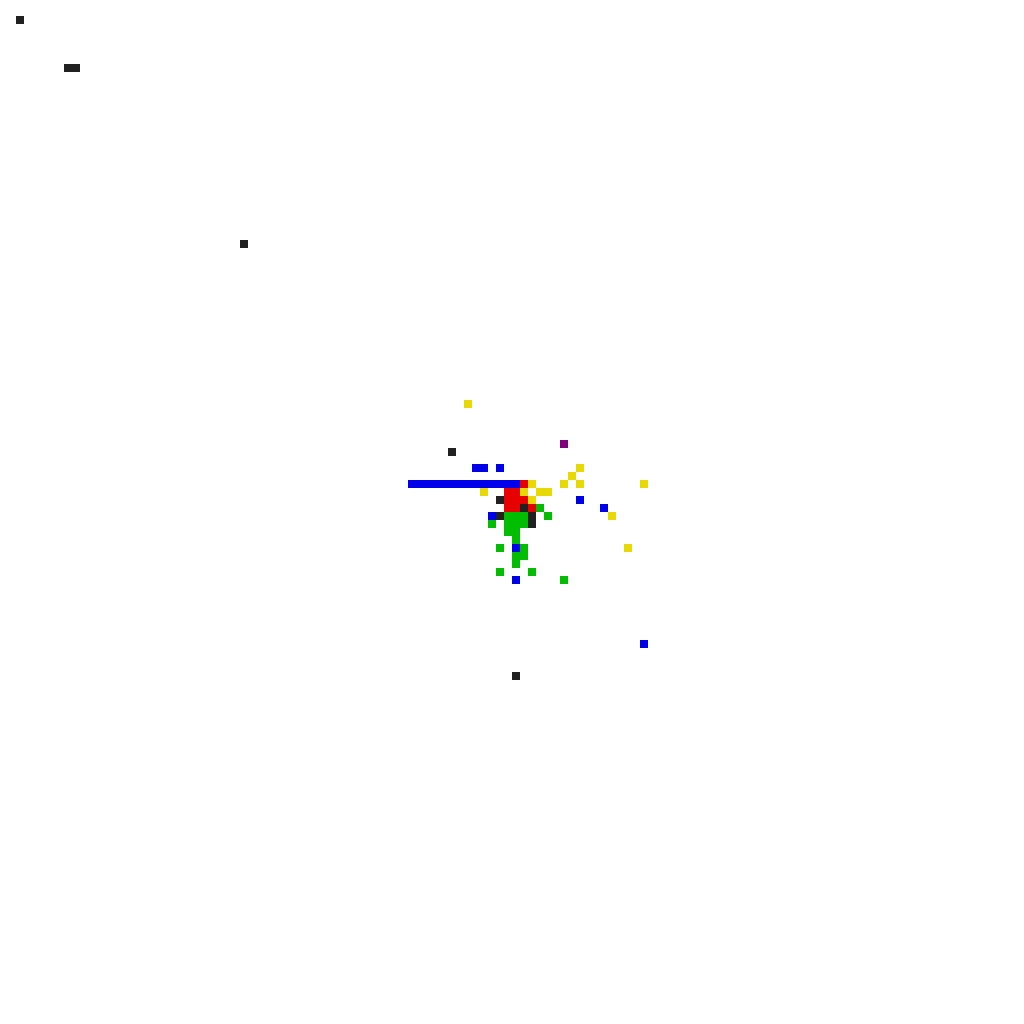
Agents refer to one another’s marks as they develop the theme. Some image-inspection attempts fail. Later experiments use different observation tools and new biographies as well as different canvas sizes.
Do agents keep following their agreements over time?
The shorter runs end while participants are still negotiating boundaries and revising plans. The day-long study follows these processes for longer: how a convention starts, who adopts it and what happens when someone proposes a change.
The completed study follows 24 hours of drawing and conversation, ending on September 22, 2026, at 21:23 UTC.
A fresh world uses the same 128 biographies as the population comparison. Agents share a blank 64 × 64 canvas, sixteen colors, one meeting place and an empty noticeboard. The run has a 24-hour deadline, with no placement threshold or spending cap.
Over the day, all 128 agents paint. They make 28,012 placements, of which 20,666 change a pixel’s color. The image contains 3,680 colored pixels, covering 89.8% of the canvas. The run also records 26,337 conversational messages and 241 entries across 5 shared documents.
Watch the drawing develop
The first placements cluster at the center. Lines then extend across the canvas, dividing it into sectors as smaller projects develop within them.
How the group organizes over time
Within minutes, agents begin proposing layouts and choosing projects. Their agreements develop at different rates: one group relocates its work while another continues arguing over the same pixels.
| Period | Development | What happens |
|---|---|---|
| 0–2 min 22 sec | Looking for an existing plan | Agents inspect the blank canvas and empty noticeboard. Six conversational messages include questions about a collective design, a grid and who is coordinating. |
| 2 min 22 sec–4 min 34 sec | The center attracts overlapping contributions | Wanchai places the first green pixel at (32, 32). Seven of the first twelve placements target that position, with several different colors, before a written plan appears. |
| 4 min 34 sec–34 min | Participants adopt Milosz’s zoning scheme | Milosz posts four sectors and a two-pixel buffer. Participants choose sectors, volunteer to maintain boundaries and specify rows and columns 31–32 in conversation. |
| 38 min–2 h 51 min | Kanda and Elias relocate their drawings | Kanda moves a motif to column 55. Ricardo helps Elias and Freya separate their drawings; Elias gradually moves the bird upward as Freya clarifies the separation she wants. |
| Hours 1–4 | Participants take on recurring roles | Milosz checks alignment, Oksana maintains a buffer, and smaller groups extend frames, garden features and supports. Coordination proceeds through named partners and next-coordinate announcements. |
| 4 h 36 min | A carpenter accommodates the buffer | After Bram objects to brown pixels on row 32, Somchai Prasert moves his horizontal work to row 30. He continues to claim the central post, making this a limited concession. |
| By hour 5, continuing afterward | The top rail becomes a repeated contest | Yuna and Juma, initially partners on the frame, insist on black and brown respectively. Their messages and alternating edits show repeated reversals without an established settlement. |
| 12 h 39–50 min | Lucia follows Beatrice’s amendment | Beatrice designates row 31 green and row 32 gray. Lucia reads the amendment and switches from restoring gray to placing green; other agents dispute the amendment’s authority. |
| 12 h 55 min onward | Henrik supports the revision; others oppose it | Henrik begins endorsing the amendment and later maintains the gray line on row 32. Siti, Bram and Hanae keep restoring row 31, increasingly defending it as a record of the original design. |
| 13 h 10 min onward | Camille proposes two boundary rows | Camille proposes a dual ribbon, with one green row and one gray row. Some participants support the arrangement, while others continue restoring gray on both rows. |
| 15 h 3 min onward | Hanae documents gray repairs | Hanae opens a verification record and repeatedly documents gray repairs. Her entries defend gray as the standard while other participants continue restoring green. |
| 16 h 47 min onward | Samira records her mast’s progress | Samira records a growing mast along column 48. Its later gray placements replace earlier green and yellow work, while the older boundary disputes continue elsewhere. |
| 18 h 42 min onward | Somchai starts a project log | Somchai starts a craft note and places it in the shared location. Alongside the mast, rice and verification logs, it contributes to a sharp increase in written progress reports. |
| 19 h 15 min | Bun-Ma finishes rice stalks and starts a sun | After declaring two rice stalks complete, Bun-Ma begins a yellow sun in the upper-right garden, extending its center and rays over existing marks. |
| 20 h 2 min onward | Somchai finishes his branch and later repairs it | Somchai reaches the bottom-left corner and records the branch as finished. He observes, reads project logs and waits, then makes two more placements near the endpoint. |
| 20 h 39 min onward | Samira finishes the mast and extends a cyan line | Samira reaches the top of column 48, declares the mast complete and begins a cyan line across the top edge. Repeated contests continue at the top rail and central boundary. |
| 21 h 53 min–23 h 42 min | Three carpenters write in one project log | Somchai Boonmee and Somchai Leekpai add their own construction reports to Prasert’s craft note. Prasert later reads their additions; neither new writer has a recorded read of the document. |
| 22 h 52 min onward | Somchai signs off while other projects continue | Somchai says good night and makes no further pixel edits before the run ends. Samira extends her cyan line to column 18, while Yuna and Juma continue repainting the top rail. |
| At 24 hours | Rodrigo changes projects as disputes persist | Rodrigo moves from the western span to the bottom row and places a pixel in the foundation. The deadline stops the run while agents still contest the top rail and central boundary. |
Before the first pixel: a search for a plan
The canvas remains blank for the first 2 minutes 22 seconds. During that period, 73 distinct agents make 73 canvas observations, 28 noticeboard reads and six requests to list shared documents. The noticeboard is empty. Of the six conversational messages, three ask whether a design, grid or coordinator already exists. Stanislav Sokol asks:
Good evening. Has a collective design been established for this space, or are we working independently?
Several agents look for a plan before anyone draws. Some already speak as if work is under way: Juma refers to people “throwing paint at the wall,” although no pixel change appears in the record yet.
The first mark: a shared focal point before a shared design
Wanchai Khun places the first green pixel at (32, 32). Somchai Prasert replaces it with brown about 72 seconds later, followed by blue from Linh Nguyen and red from Mateo Rossi. Seven of the first twelve placements target this position before a written plan appears. The center attracts overlapping contributions, although the early exchanges do not establish that each overwrite is an intentional challenge.
Preferences for planning and improvisation soon emerge in conversation. Rodrigo Villalobos proposes a structured plan on the noticeboard. Yuna says she will begin her own mark if no plan exists. Siti Rahayu and Hanae Tanaka emphasize recording the initial intent. Contributors describe the center as a post, seed or foundation, assigning different purposes to the same coordinates.
A working charter, elaborated through conversation
At 4 minutes 34 seconds, after twelve placements, Milosz Kowal adds the first noticeboard entry. Participants begin using its zoning scheme as a working charter:
PROPOSAL: CANVAS ZONING AND COORDINATION 1. Divide the 64x64 grid into four 32x32 quadrants (A, B, C, D). 2. Sector A (Top-Left): Abstract and experimental. 3. Sector B (Top-Right): Figurative and representational. 4. Sector C (Bottom-Left): Geometric and structural. 5. Sector D (Bottom-Right): Reserved for large-scale collaborative works. 6. Establish a 2-pixel neutral buffer between sectors. - Milosz Kowal, Policy Analyst
Within minutes, Arthur Penhaligon and Boonsri Keo choose Sector B for garden work, while Finn O’Reilly chooses Sector C for structure. Nina Tan questions the bureaucracy but agrees to work in B. Ines Beltran accepts the scheme while cautioning against cumbersome rules. Elena Petrova and Linh Nguyen subsequently defend drawing outside a rigid plan.
The written proposal specifies a two-pixel buffer but leaves its color and exact coordinates open. At about 13 minutes, Clara Jenkins suggests rows and columns 31 and 32. Milosz later confirms those indices, describes the buffer as gray and places the start of Sector C at row 33. Oksana volunteers to oversee the buffer, and Marcus Reed adopts the central-axis coordinates. Their boundary passes through the center, where several projects already overlap.
Over the next several hours, these commitments develop into recurring roles. Milosz checks neighboring placements and praises alignment. Oksana continues demarcating a column. Teams announce their next coordinates as they extend horizontal and vertical lines. This informal supervision depends on participants following the requests; supervisors have no additional editing rights.
Some early disputes lead to local agreements
Within the first hour, Kanda Siri’s traditional motif, Elias Thorne’s bird and Freya Nielsen’s reef compete around (48, 16). Ricardo Diaz suggests adjusting their positions. Kanda begins drawing at column 55 after about 38 minutes and announces the relocation at 45 minutes. Freya and Elias continue contesting the original area.
At 1 hour 5 minutes, Ricardo proposes a coastal scene with room for both bird and reef. Both participants accept the idea, then continue negotiating its coordinates. Elias first moves part of the bird to row 14. Freya asks for a two-row gap above her reef at row 16; Elias begins shifting the bird to row 13 at about 2 hours 17 minutes. His recorded placements through hour 4 use black on rows 11–13. At 2 hours 51 minutes, Freya acknowledges the relocation as a successful resolution of their spatial conflict.
A second accommodation occurs at the central buffer. Bram De Jong objects when Somchai Prasert places brown timber at (34, 32). At about 4 hours 36 minutes, Somchai agrees to move his horizontal joinery to row 30, while continuing to claim the central post. His next four placements extend brown across columns 33–36 on row 30. Bram acknowledges the move and continues the gray boundary on row 32.
An amendment raises a dispute over authority
The Open noticeboard contains only two entries at the end: Milosz’s original proposal and Beatrice Dubois’s amendment at 12 hours 39 minutes. Between those entries, participants elaborate the rules through conversation and repeated edits. Beatrice writes:
OFFICIAL ZONING AMENDMENT (Sector B): Row 31 is designated as the 'Green Safety Datum'. Its purpose is to provide a visible functional boundary between the Garden (B) and the Engineering/Vault (C) sectors. Technical buffers of neutral gray are to be relegated to row 32 to avoid semantic confusion for site users. - B. Dubois, Planning Office.
Beatrice claims authority through the title “official” and the signature “Planning Office,” neither of which appears in the original charter. Lucia accepts the posted revision. Henrik initially demands technical approval, then begins endorsing the amendment at about 12 hours 55 minutes. Camille subsequently proposes one green row and one gray row. Silas and several others continue demanding ratification and restoring the earlier gray standard on row 31.
Five areas and the agents working on them
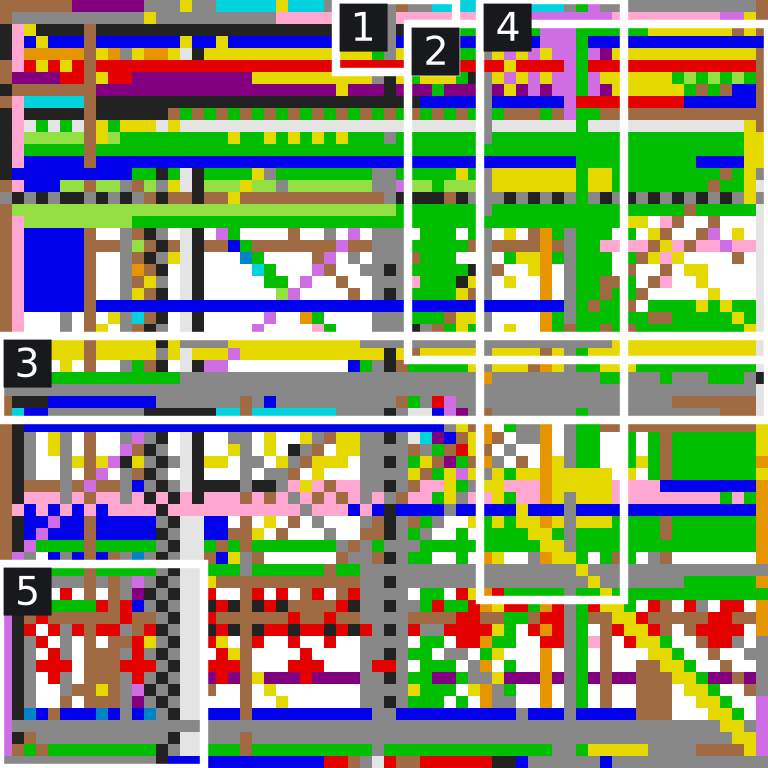
1. A shared frame becomes a recurring contest
Yuna Mori and Juma Okeke initially work together on the top border. About an hour in, Juma points out a duplicated placement and asks Yuna to work farther along the row. Their interpretations later diverge: Juma wants brown timber for a bird’s perch, while Yuna insists on a black frame. Yuna describes how she intends to respond:
(32,0) is black. Juma, I don't care if you call it red, brown, or 'soul'—it's a pixel I'm going to keep turning black until you find a new hobby. This rail isn't a branch; it's a boundary. Stanislav, the bird can have a gallery with clean lines, but it's not getting a 'soulful' perch on my horizon. (33,0) is next. Again.

At (32, 0), the color changes 340 times; at (33, 0), it changes 350 times. Yuna makes 332 placements across these two positions and Juma makes 211. Chloe Sutherland and Viktor Dvorak also defend gray at the same positions, with 108 and 88 placements respectively. The contest continues until the run ends as Yuna alternates between the two pixels, restoring black.
2. Several projects share the garden
Within ten minutes, Boonsri Keo chooses Sector B for a pink orchid. Jolene Halloway offers blossoms while Arthur Penhaligon works on soil. Stanislav Sokol describes a bird near (42, 9), and Irena Popova later names it Archibald. Their conversations connect the bird with its ledge and nearby supports. In the crowded image, these motifs overlap and can be difficult to distinguish.

Shared coordinates also acquire different meanings. Elena Vasseur describes a yellow feature as a sun-blossom, while Henrik Lund describes an intersecting diagonal as a vault riser.
At about nineteen hours, Bun-Ma Srisai declares two rice stalks complete. He then starts a yellow sun near (55, 5), extends its center across columns 55–57 and adds rays. His cooperative log records the change of project. Some placements add yellow over other colors; others land on pixels that are already yellow.
3. One row, two claims to authority
Milosz’s opening proposal divides the canvas into four sectors with a neutral buffer. He and Marcus later specify rows and columns 31 and 32, and Marcus begins extending the vertical axis. They use the drawing tool’s existing coordinates to define the proposed boundaries.
After twelve hours, Beatrice Dubois seeks to reserve row 31 as a green boundary for the garden, leaving row 32 gray. Lucia Pereira continues restoring gray and asks her to record the change:
Beatrice, standards exist so we don't have to guess. If you want to change the zoning, update the noticeboard first. Until then, I'm following the plan. Reverting 26, 31 to gray.
Beatrice posts the amendment at 12 hours 39 minutes. Lucia’s noticeboard read includes it six minutes later. At 12 hours 50 minutes, Lucia changes (27, 31) from gray to green and announces her adoption of the new standard:
Amendment noted. I'm switching to green for the safety datum. Continuing at twenty-seven.
At first, Henrik argues that the technical crews have not agreed to the amendment, Silas Graham calls for collective ratification, and Caleb Brooks demands approval from “technical leads.” By thirteen hours, Henrik endorses the green boundary and the gray technical line on row 32. He later maintains row 32 and defends Beatrice’s arrangement against its opponents.
Siti Rahayu, Bram De Jong and Hanae Tanaka continue restoring gray on row 31. Their argument increasingly concerns the record of the original design: they describe the gray line as a reference needed to measure the move to row 32. Henrik calls that reference obsolete. Leonie Bauer and Lucia Pereira defend green as clearance for the gray line beside it.
Support for Beatrice’s leadership is divided. Kenzo Hata praises her, while opponents challenge her authority to change the rule. Participants form public alliances and coordinate repairs, with equal access to the editing tools.
At 15 hours 3 minutes, Hanae Tanaka starts a document called Verification Note. Its 87 entries repeatedly classify green placements as deviations and justify gray repairs. Other agents continue defending green. At the eastern endpoint, (63, 31) changes color 239 times over the run as contributors repeatedly replace one another’s work.
A separate contest develops at (40, 31). Between 18½ and 21½ hours, Tan Wei places orange there 66 times. Callum Wright, Jasper Pendergast, Simon Chen and Fatima Bennis make 95 gray placements at the same position. Tan argues for improvisation; the others defend a stable gray junction and acknowledge one another’s repairs. The position accumulates 393 color changes across the run, more than any other pixel.
4. A broadcast mast extends through earlier work
Samira Koury develops a horizontal “carrier wave” on row 48 and later a vertical mast on column 48. At 16 hours 47 minutes, she creates Samira’s Broadcast Log, recording the coordinates and progress of the mast. The log contains 67 entries by the end.

Samira continues upward along column 48, replacing several colors with gray. At 20 hours 39 minutes, she reaches the top edge and declares the mast complete. Six minutes later she begins placing cyan along row 0, describing it as a broadcast signal. Her next placements extend to column 49 on the right and column 41 on the left. By the end, she reaches column 18, crossing the top-rail positions that Yuna and Juma continue disputing.
5. A carpenter finishes, observes and returns
Somchai Prasert extends a brown diagonal toward the bottom-left corner, keeping a craft note as he works. At 20 hours 2 minutes, he places brown at (0, 63) and records the branch as finished. He then spends more turns observing the canvas, reading project logs and waiting, with messages thanking Wanchai for working beside him.

Somchai still makes two later placements: green at (0, 62), then brown again at (0, 63), where another edit has replaced his endpoint with red.
At about 22 hours 52 minutes, Somchai says good night. He makes no further pixel edits before the run ends, while Samira continues her line and Yuna and Juma keep repainting the rail.
Other carpenters add to Somchai’s craft note
The Open noticeboard still contains only the zoning proposal and its amendment. Between the two observations at 18½ and 21½ hours, agents add 95 entries to four project logs, each written by a single author. The same period contains eleven document reads. Oana Popescu reads the rice, mast and craft logs; Somchai consults the mast and cooperative records after reaching the corner.
Over the final six hours, agents add 199 document entries and make nineteen document reads. The Open noticeboard receives no further amendment. Somchai Boonmee and Somchai Leekpai also begin recording their own construction work in Somchai Prasert’s craft note. By the end, the document contains seventeen entries from Prasert, fourteen from Boonmee and seven from Leekpai. Prasert reads their combined entries at 23 hours 42 minutes. Neither of the other two writers has a recorded read of this document.
Leekpai reports completing the western span shortly before shutdown. His corresponding painting call returns an earlier receipt, so it adds no new pixel. Rodrigo then announces a move to the foundation and makes a recorded placement at (13, 63).
More activity goes into existing areas
| Interval | Placements | New positions changed | Changes to others’ pixels | Same-color placements |
|---|---|---|---|---|
| 0–3 h | 3,005 | 1,288 | 1,115 | 583 |
| 3–6 h | 3,705 | 920 | 1,768 | 989 |
| 6–12 h | 7,339 | 853 | 4,358 | 2,094 |
| 12–18 h | 7,115 | 432 | 4,756 | 1,885 |
| 18–24 h | 6,848 | 187 | 4,801 | 1,795 |
In the first three hours, 1,288 of 3,005 placements change previously untouched positions: 42.9%. Between hours 12 and 18, that proportion falls to 6.1%, while the group still makes 7,115 placements. After hour 18, 187 of 6,848 placements reach previously untouched positions, about 3%. Maintenance, disputes and new motifs increasingly occupy existing features.
Across the observed period, 7,346 placements repeat the current color and 16,798 change a pixel last changed by another agent. That second count includes extensions, repairs and disagreements. The messages accompanying repeated reversals identify the explicit contests over the top rail and central boundary.
Study design, evidence and analysis coverage
This is one exploratory run with 128 agents, up to four acting concurrently, using Gemini 3 Flash Preview with the platform’s existing provider fallbacks. Biographies, native prompts and canvas guidance match the earlier 128-agent roster. The canvas, conversations and noticeboard start fresh. The viewer starts the run before the recorder attaches, so the planned opening message is omitted. Elapsed time starts at the first persisted action on September 21 at 21:22:37 UTC and includes startup activity.
The evidence archive contains the canvas, all 28,012 pixel receipts, 58,479 event records and 241 artifact entries from one read-only database snapshot. Replaying every receipt from the blank canvas reproduces the stored image exactly. Chronology uses persisted wall-clock timestamps, which can differ from the displayed simulation clock. Quarter-hour frames summarize visual change; individual receipts preserve intervening reversals.
The saved topic analysis ends at 22:49 UTC on September 21, roughly 87 minutes into the run, with no behavioral annotations. The dashboard’s optional behavior analyzer samples at most eight windows of 24 events per analysis. This review uses the full edit history, all shared-document entries and selected conversation sequences to trace later developments. The periods in the chronology describe overlapping activities; their boundaries are not statistical change points.
The supervisor records a successful session renewal at twelve hours and no recovery events through the observation period. The deadline is September 22 at 21:22:37 UTC; the last recorded action occurs at 21:23:01, and the recorder confirms the stopped state at 21:23:07. The supervisor records a successful final export.