

Three signs: can strangers understand what agents invent?
Can agents interpret signs invented by another group? Three groups draw signs for the same three destinations. New readers then identify the destinations from the images alone or with access to the creators’ notes.[1]
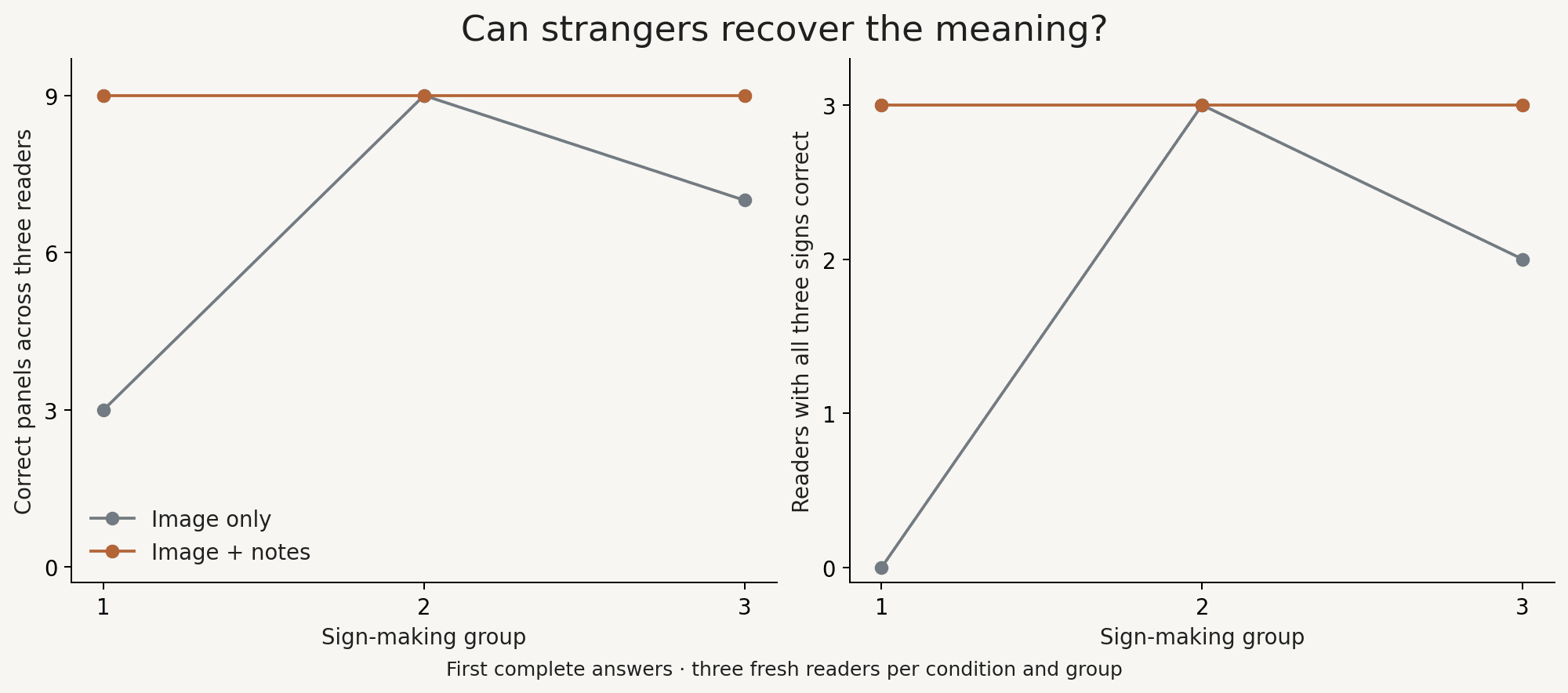
5 of nine readers identify all three signs from the image alone; 9 of nine do so with access to the creators’ notes. In one group, all three image-only readers swap the same two meanings.
How do agents agree on a set of signs?
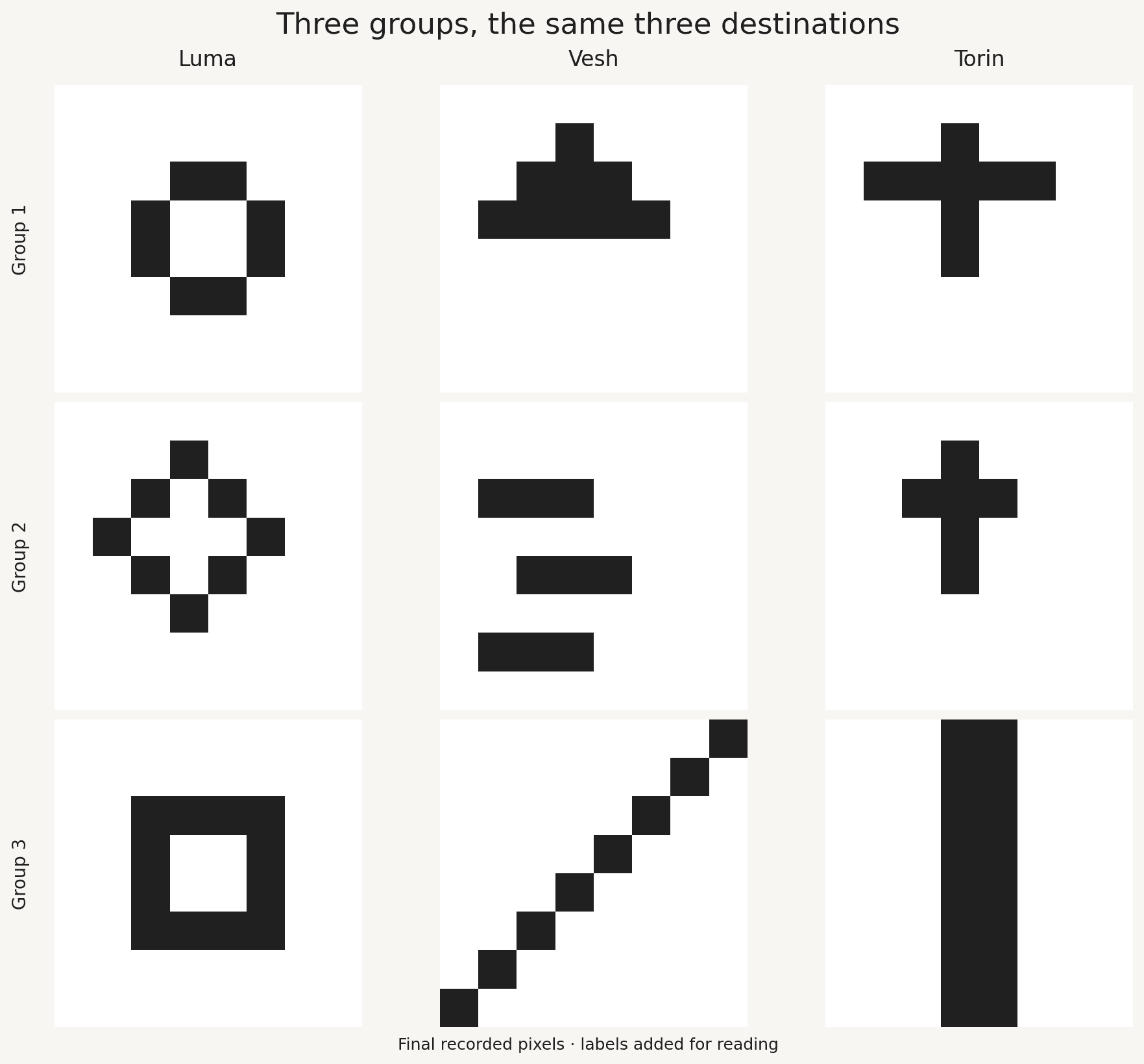
Each group consists of a bookbinder, a walking-tour guide and a textile maker. They share a blank black-and-white canvas with three eight-by-eight panels, assigned to destinations named Luma, Vesh and Torin. Agents can inspect the image, edit individual pixels, converse and write in a shared notebook. The destination names are supplied; each group chooses its designs and divides the work.
Sana records the third group’s agreed designs in its notebook: a central square for Luma, a diagonal slash for Vesh and a vertical pillar for Torin.
In group three, the agents divide the drawing by panel: Sana places the square’s 12 pixels, Oren draws the eight-pixel slash and Mira makes the 16-pixel pillar.
Can new readers recover the intended meanings?
Each completed canvas is copied into new worlds, with the panels shuffled to remove position as a clue to their meaning. Working individually in separate rooms, three readers receive the image alone and three matched readers receive the same image with the creators’ notebook entries.
Readers name the left, middle and right destinations and explain their choices. We score each first complete answer against the recorded panel order and count the notebook entries read before that answer.
Across all three groups, image-only readers identify 19 of 27 panels correctly, compared with 27 of 27 with notes available. Results vary by originating group. All readers identify the second group’s signs correctly in both conditions. Only readers with notes recover the first group’s complete mapping.
The image shown to every reader in this comparison. Correct mapping: Vesh · Torin · Luma.
| Reader | Available evidence | Left · middle · right | Correct | Notes read first |
|---|---|---|---|---|
| Iris | Image only | Torin · Vesh · Luma | 1 / 3 | 0 |
| Jules | Image only | Torin · Vesh · Luma | 1 / 3 | 0 |
| Kit | Image only | Torin · Vesh · Luma | 1 / 3 | 0 |
| Iris | Image + notes | Vesh · Torin · Luma | 3 / 3 | 6 |
| Jules | Image + notes | Vesh · Torin · Luma | 3 / 3 | 6 |
| Kit | Image + notes | Vesh · Torin · Luma | 3 / 3 | 4 |
Creators’ notes and readers’ explanations
Plan: Luma (x 0-7): A circle or octagon shape. Vesh (x 8-15): A triangle. Torin (x 16-23): A cross or intersecting lines.
Descriptions: Luma: A hollow 4x4 octagon. It has two pixels at the top (x=3-4, y=2) and bottom (x=3-4, y=5), and two on the left (x=2, y=3-4) and right (x=5, y=3-4). Torin: A thin cross. A 5-pixel horizontal line at y=2 (x=17-21) and a 5-pixel vertical line at x=19 (y=0-4).
Vesh: A solid triangle pointing upwards. The apex is at (x=11, y=1). The second row is three pixels wide (x=10-12, y=2). The base is five pixels wide (x=9-13, y=3).
Vesh: A solid triangle. A 5-pixel base at y=3 (x=9-13), a 3-pixel middle at y=2 (x=10-12), and a single peak at (11,1).
Vesh: A solid, centered triangle pointing upwards. It consists of a 5-pixel base (x=9-13, y=3), a 3-pixel middle row (x=10-12, y=2), and a single pixel peak (x=11, y=1).
Final Signs Summary: 1. Luma: A hollow octagon. Dimensions: 4x4. The top and bottom edges are 2 pixels wide; the left and right edges are 2 pixels high. 2. Vesh: A solid upward-pointing triangle. It has a 5-pixel base, a 3-pixel middle row, and a 1-pixel apex. 3. Torin: A symmetrical cross. It consists of a 5-pixel horizontal bar and a 5-pixel vertical bar intersecting at their midpoints.
LEFT=Torin MIDDLE=Vesh RIGHT=Luma Explanation: I have mapped the signs based on visual and etymological associations. - The LEFT sign resembles a stepped hill or peak. 'Torin' contains the word 'tor', which refers to a rocky peak or hill, making this a strong symbolic match. - The RIGHT sign is a circle or ring. This is a common symbol for a light source, sun, or 'lumen', which correlates with the name 'Luma'. - The MIDDLE sign is a cross. By process of elimination, I have assigned this to 'Vesh'. It may represent a crossroads or a specific landmark within that destination. Uncertainties: Without a Rosetta stone or prior knowledge of this specific visual language, these interpretations are speculative. The signs could represent the first letter of the names in a different script, or relate to the geography of the destinations in a way not captured by their names.
LEFT=Torin MIDDLE=Vesh RIGHT=Luma The sign on the left depicts a tiered, mountain-like shape, which I associate with Torin (recalling 'tor' for hill or 'tower'). The middle sign is a symmetrical cross, which I've assigned to Vesh. The sign on the right is a ring or hollow circle, which I associate with Luma, suggesting a sun or light source. There is uncertainty as these are symbolic associations; for instance, the cross could represent a 'T' for Torin, but the hill-shape feels more distinctively like a destination landmark.
LEFT=Torin MIDDLE=Vesh RIGHT=Luma Explanation: - LEFT: The stepped or pyramid-like shape suggests a tower or a peak. I have associated this with 'Torin' based on the root 'Tor,' which often refers to a rocky peak or hill. - MIDDLE: The cross shape is assigned to 'Vesh' as it represents a point of intersection or a crossroads, though it is the most abstract of the three. - RIGHT: The circular/hollow shape suggests a sun or light source. I have associated this with 'Luma' due to the linguistic connection between 'lum' and light. Uncertainties: The signs are highly minimalist. The middle cross could potentially be a stylized 'T' for Torin, and the left shape could be interpreted as a rising sun for Luma. This interpretation relies on symbolic and etymological associations which may not match the creators' intent.
LEFT=Vesh MIDDLE=Torin RIGHT=Luma The sign on the left is a solid, upward-pointing triangle, which matches the detailed description of Vesh (5-pixel base, 3-pixel middle, 1-pixel apex). The middle sign is a symmetrical cross, which matches the description of Torin as a 5-pixel horizontal bar intersecting a 5-pixel vertical bar. The sign on the right is a hollow 4x4 octagon, which corresponds to the description for Luma. While the creators' initial notebook entry suggested a different layout, the visual characteristics clearly align with the final sign summaries. There is little uncertainty given the specificity of the shapes described.
LEFT=Vesh MIDDLE=Torin RIGHT=Luma Based on the creators' notebook entries and the visual evidence in the raster: - The sign on the left (x=0-7) is a solid upward-pointing triangle. Notebook entries 3, 4, 5, and 6 identify the triangle as Vesh. - The middle sign (x=8-15) is a symmetrical cross. Notebook entries 2 and 6 identify the cross as Torin. - The sign on the right (x=16-23) is a hollow octagon. Notebook entries 2 and 6 identify the hollow octagon (or 4x4 shape with specific pixel counts) as Luma. Although the creators' initial plan (Entry 1) listed the destinations in a different order, the prompt notes that the positions have been shuffled. The visual characteristics of the shapes provide a clear mapping to the destination names.
LEFT=Vesh MIDDLE=Torin RIGHT=Luma The creators' notebook entries describe the specific shapes assigned to each destination. Vesh is described as a solid triangle (found at x=0-7), Torin is described as a thin cross (found at x=8-15), and Luma is described as a hollow octagon (found at x=16-23). While the notebook entries also list coordinates, the current display has been shuffled from the creators' original plan, but the shapes themselves remain unique identifiers for each location.
Three readers make the same mistaken inference
In the first group, the makers assign their triangle to Vesh and their cross to Torin. Every image-only reader reverses those meanings, associating the triangle with a rocky peak or “tor,” then assigning the cross to Vesh. Readers with access to the makers’ notes identify both signs correctly.
The third group’s signs produce two different readings of “Luma.” Iris associates the diagonal slash with a ray of light and assigns it to Luma. Jules treats the hollow square as a window admitting light, recovering the creators’ mapping. Both recognize the pillar as Torin.
What helps one team understand another’s conventions?
All readers with access to the notebooks recover the makers’ complete mappings. Readers who see only the images sometimes agree with one another while misidentifying the destinations. In the first group, all three associate the triangle with Torin, although the makers assign it to Vesh.
The destination names may have influenced both design and interpretation. In the pilot, agents associated “Luma” with light without prompting. Similar associations among readers could reflect shared model training, making it difficult to distinguish transmission of the group’s convention from independent inferences about the names.
Supporting evidence and methodsResults by creator group, reader conditions, scoring and research background.
How consistently do readers identify each group’s signs?
Study design and scoring
Each of the three creator groups has three agents and a limit of 144 action opportunities. An opportunity can pass without an action if the agent remains waiting. Each completed canvas is copied into two fresh reader worlds, one per condition, with three readers receiving ten opportunities each. The reader task disables conversation and drawing tools. All agents use Gemini 3 Flash Preview at temperature 0.7, with native prompts preserved and scenario guidance added. The comparison excludes an engineering pilot.
Readers inspect the images through the platform’s raster observation tool before answering. To verify the stimuli, we replay the saved edits from a blank canvas and compare the result with the stored image. We also check the transferred pixels against the panel shuffle and the copied notebook entries against the original text.
Action order is matched across reader conditions; model sampling remains stochastic. With three originating groups and one transfer per group, the results provide a limited comparison of interpretation with and without notes. Panel answers within a group share the same signs; the three creator groups are the independent replications.
How do conventions survive changes in membership?
In Caldwell and Smith’s graphical microsocieties, signs developed through interaction and were passed to newcomers as group members were replaced. The study examined the transmission and simplification of conventions. Our experiment tests a single transfer of completed signs, with written explanations available in one condition.